Tier 4
DATA CENTER CLASSIFICATION
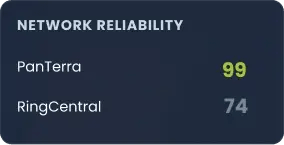
99.999%
NETWORK AVAILABILITY
0
PUBLIC CLOUD DEPENDENCIES
MULTI-DC
GEOGRAPHIC REDUNDANCY
An honest, side-by-side look at which UCaaS platform is built for mid-market and enterprise — and which one is trying to be everything to everyone.
PanTerra made a deliberate choice: serve mid-market and enterprise customers exceptionally well inthe United States, rather than everyone adequately.

PanTerra isn't chasing quarterly earnings or investor pressure. As a privately held company, every product decision is made around what enterprise customers actually need — not what drives mass-market signups.

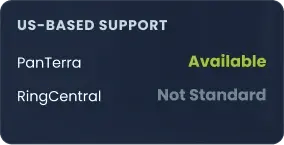
Every support call, every onboarding session — handled by US-based engineers who understand enterprise deployments. Not an offshore call center, and not an upsell.

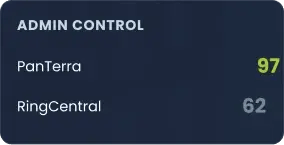
If your team ever managed an Avaya, Mitel, or ShoreTel PBX, you'll feel at home. PanTerra's Admin Portal gives IT the depth of control your organization requires.

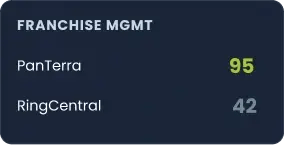
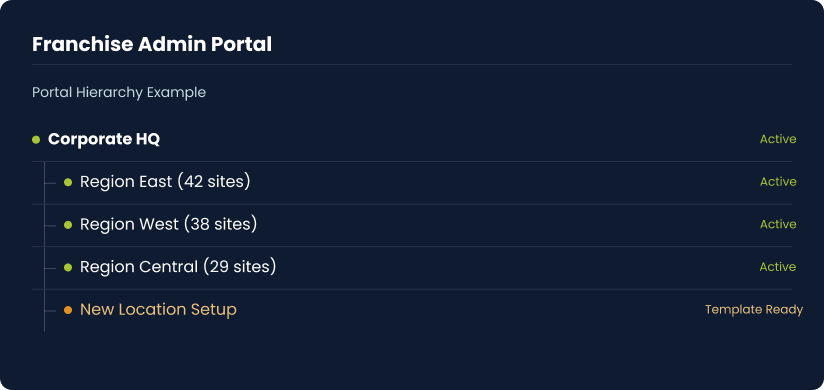
Manage billing, provisioning, and communications across dozens or hundreds of franchise locations from a single portal — with consolidated reporting and site-level control.

PanTerra owns its backbone across multiple Tier 4 data centers in the United States. No AWS, no Azure, no Google Cloud — no shared-tenant cloud outages dragging down your phone system.
Every deployment includes a dedicated US- based Project Manager who owns your implementation from kickoff through go-live. No ticket queues, no hand-offs.

Replicate your existing Avaya Communication Manager call routing, hunt groups, and ACD configurations with familiar administrative controls in the cloud

Seamlessly map your Avaya VDN structures to PanTerra's cloud-native routing engine — no complex re-engineering required

Preserve your existing extension plan and user assignments. Bulk import thousands of stations with complete profile data

Get the same depth of call center analytics you had with Avaya CMS — real-time monitoring, historical reports, and agent performance metrics

Maintain your distributed administration model with per-site admin controls that mirror your Avaya site administrator structure

Modern cloud-native endpoints with feature parity to your legacy Avaya J100/J179 deployment — or bring your own device

Direct feature-to-feature mapping from your Mitel MiVoice (3300) system — ACD paths, hunt groups, call rerouting, and day/night modes replicated in PanTerra
Class of Service and Class of Restriction structures migrate seamlessly — maintain your existing user privilege model without rebuilding from scratch

Preserve your organization's speed dial lists and centralized directories. Users retain familiar shortcuts and contact access post-migration

Upload your existing MoH audio and IVR prompts directly into PanTerra — no need to re-record or re-license existing voice assets

If you managed multiple tenants via Mitel ESM, PanTerra's enterprise portal provides equivalent multi-entity administration with superior visibility
PanTerra's unified client delivers collaboration features comparable to MiCollab — softphone, chat, presence, conferencing — without per- user licensing complexity
Your ShoreTel workgroup configurations migrate directly to PanTerra hunt groups and ACD queues — preserving agent assignments, routing logic, and overflow behavior
PanTerra's Admin Portal mirrors the intuitive design philosophy ShoreTel users appreciate — drag-and-drop call flows, visual routing, and straightforward configuration

Preserve user voicemail boxes and greetings during migration. No lost messages, no re-recording — seamless voicemail continuity for every user

Eliminate on-premise ShoreGear switches at remote sites. PanTerra's cloud architecture delivers distributed features without distributed hardware

Full-featured attendant console with call park, transfer, directory lookup, and presence monitoring — everything your receptionists relied on with ShoreTel
Continue using compatible IP phones or upgrade to modern cloud endpoints — flexible migration path accommodates your hardware refresh timeline

Your Cisco Unified Communications Manager call processing rules translate to PanTerra's cloud platform — partitions, calling search spaces, route patterns preserved
Replicate your CUCM device pool architecture with PanTerra's site- based policy management — maintain centralized control with location-aware routing
Your complex dial plan logic — translation patterns, route filters, digit manipulation — converts to PanTerra's cloud routing with expert migration assistance
Contact center scripts and IVR call flows from Cisco UCCX rebuild in PanTerra's visual call flow designer — or integrate with Five9 for advanced CCaaS

PanTerra's cloud architecture eliminates the need for Automated Alternate Routing and Survivable Remote Site Telephony — built-in redundancy replaces complex failover design

Replace Cisco Jabber with PanTerra's unified communications client — superior mobile experience, integrated video, and AI-powered features Jabber never delivered



 PanTerra Networks Support
US-Based, Included
Every PanTerra customer gets US-based support staffed by engineers who understand enterprise phone systems. No tiers, no offshore routing, no premium support upsell.
 Dedicated onboarding Project Manager, US-based, included
All support handled by US-based technical staff
No additional cost at any tier
Same team from onboarding through steady-state support
Engineers experienced with Avaya/Mitel/ShoreTel migrations
 RingCentral Support
Standard: Offshore Routing
RingCentral's standard support model routes customers to a Philippines-based call center. US-based onboarding assistance is available as a paid add-on, not included by default.
 Standard onboarding: self-serve or Philippines call center
US-based onboarding assistance available at added cost
Standard support handled offshore
Premium support tiers require additional investment
Support structure optimized for high-volume SMB scale
Franchise operators and multi-location enterprises need centralized oversight without losing site-level control. PanTerra was designed with this exact use case in mind.


 PanTerra Is the Right Fit If...
 You have 50+ seats and complex call routing requirements
Your team previously managed an Avaya, Mitel, or ShoreTel PBX
You operate multiple locations or franchise units
US-based support is non-negotiable for your IT organization
Uptime and reliability are mission-critical to your business
You want a dedicated PM through onboarding — included, not
You need consolidated billing across locations or divisions
You're evaluating Microsoft Teams integration with AI capabilities
 RingCentral May Be a Fit If...
 You're a smaller SMB with straightforward communications needs
You're comfortable with self-serve onboarding processes
Deep admin control and enterprise configuration aren't priorities
You have in-house IT bandwidth to manage onboarding independently
You're evaluating a broad ecosystem of third-party app integrations
Brand recognition in a large vendor selection process matters